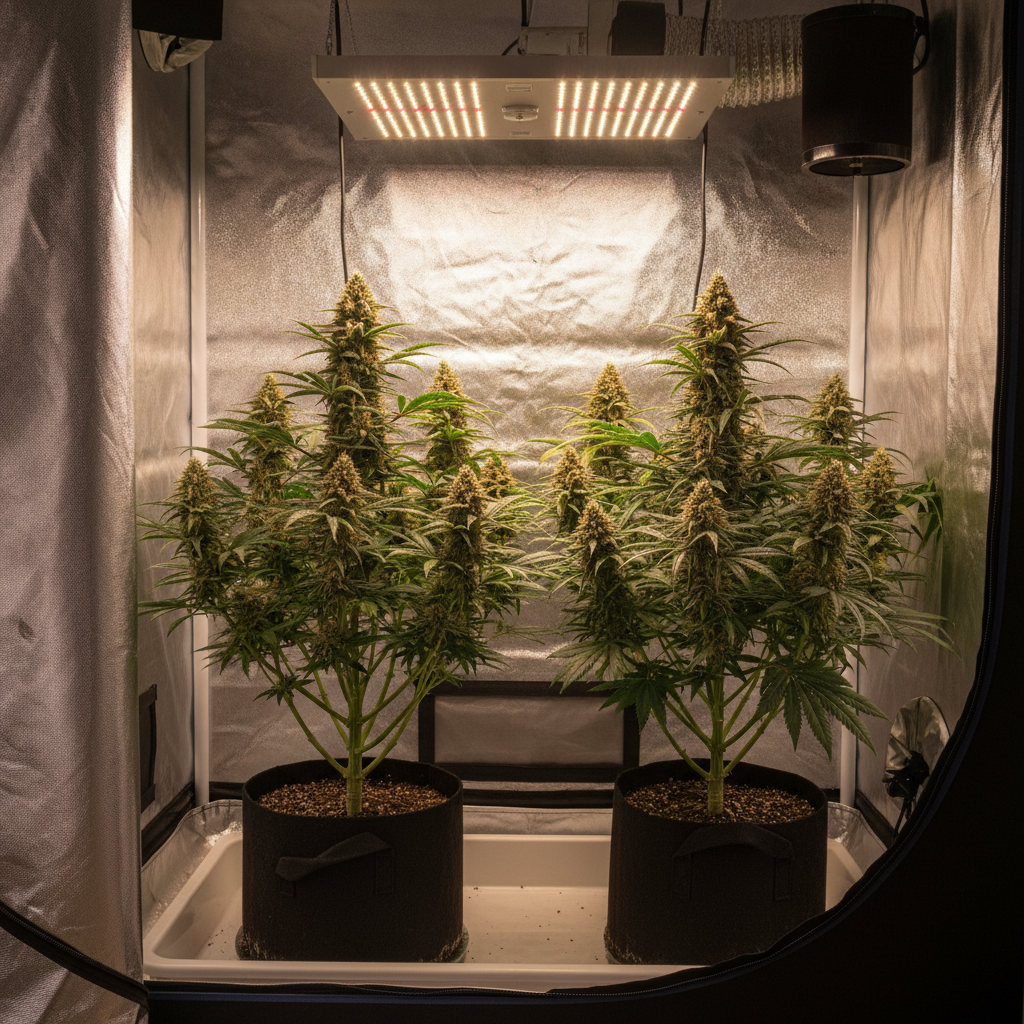
Why Your Grow Tent Choice Matters More Than You Think
A grow tent isn't just a box that contains your plants — it controls light distribution, airflow efficiency, humidity management, and how effectively your equipment performs. The difference between a well-matched tent and a mismatched one can mean the difference between dense, resinous buds and a disappointing harvest.
October is actually one of the best times to invest in tent equipment. Outdoor growers are wrapping up their harvest right now, and if you're planning your first or next indoor grow, getting your setup dialed in this fall means you'll be ready to drop seeds in November and harvest in late winter or early spring. This guide covers everything you need to know to make a smart purchase — and avoid the mistakes most beginners make the first time around.
Before you buy anything, check your state's plant count limits at /states. California, Colorado, Michigan, and most other legal states allow 3–6 plants per adult. That number directly determines what tent size you actually need.
Understanding Grow Tent Sizes: The Right Fit for Your Space and Goals
Tent dimensions are listed as width × depth × height, typically in feet or centimeters. Most manufacturers use metric internally but advertise in feet. Here's a practical breakdown of the most common configurations:
2×2 Tents (60×60 cm)
A 2×2 is the smallest setup worth buying for cannabis. It comfortably fits 1–2 plants in 3–5 gallon containers and works well for autoflowers or single-plant photoperiod grows. Expect 1–2 oz per harvest from a well-managed 2×2 with a quality 100–150W LED. These tents are ideal for micro-grow situations — apartments, closets, or states with 1–2 plant limits. They're also popular as dedicated mother-plant or clone tents.
2×4 Tents (60×120 cm)
This is the sweet spot for a lot of home growers. A 2×4 supports 2–4 plants comfortably and accepts a single 200–300W LED panel or two smaller lights side by side. It fits in a closet, spare bathroom, or corner of a basement without dominating the space. Yields typically land between 3–6 oz per harvest with solid technique and good genetics. This size also works well as a veg tent paired with a larger flowering tent if you want to run perpetual harvests.
3×3 Tents (90×90 cm)
The 3×3 is underrated. It holds 4 plants in 5-gallon pots with room to train them, and it's more efficient than a 4×4 if you're only growing 3–4 plants. A 250–300W LED fills this space well. The square footprint is easier to fit in awkward spaces than a 4-foot-wide tent.
4×4 Tents (120×120 cm)
The 4×4 is the most popular configuration for serious home growers. It holds 4–9 plants depending on pot size and training method, and it accepts a 400–600W LED comfortably. Most quality tents, lights, and ventilation systems are designed around this footprint. If you want to grow 4–6 plants with a proper canopy management approach like SCROG or LST, a 4×4 is your benchmark. The VIVOSUN 4×4 Grow Tent is one of the most consistently reviewed options at this size — the heavy-duty zippers and 98% reflective Mylar lining are genuinely good for the price point.
4×8 and 5×5 Tents
These are production-level setups for the dedicated hobbyist. A 4×8 essentially runs two 4×4 light footprints, which lets you run perpetual harvests — veg one side while the other flowers. These make sense if your state allows 6–12 plants and you're committed to a steady supply. They require a proportionally larger ventilation and dehumidification investment, so budget accordingly.
Key Features to Look for in a Quality Grow Tent
Not all grow tents are equal. The price range runs from $40 to over $400 for the same basic footprint, and the differences matter. Here's what to actually inspect:
Frame Material and Gauge
Better tents use 19mm steel poles. Budget tents use thinner metal or plastic connectors that flex, sag, and eventually fail under the weight of lights and carbon filters. If a tent's frame listing doesn't specify pole diameter, assume it's undersized. A 4×4 tent needs to support 20–40 lbs of hanging equipment without the frame bowing inward.
Canvas Thickness and Light Proofing
Look for 600D–1680D canvas (denier). Thicker canvas blocks light leaks more reliably and holds up to years of use. Light leaks during the dark period are a serious problem for photoperiod plants — even a pinhole of light can disrupt flowering and trigger hermaphroditism. Quality tents use double-stitched seams and light-blocking sock-style ports.
Interior Reflectivity
Interior walls should be lined with Mylar rated at 95–98% reflectivity. This isn't a minor detail — a highly reflective interior can improve usable light at canopy level by 20–30% compared to a dull or patchy lining, which either means better yields or lets you run a slightly lower-wattage light and save on electricity.
Zipper Quality
Zippers are the single most common failure point on grow tents. Cheap zippers snag, tear the fabric, and create light leaks. High-quality tents use oversized metal or YKK-style zippers with smooth operation. Read reviews specifically for zipper complaints before purchasing any tent.
Viewing Windows and Access Ports
An observation window with a velcro cover is a legitimate quality-of-life feature — you can check on your plants without opening the tent during the dark period. Port placement also matters: you want cable ports at the top for power cords and low ports for drainage and fresh air intake. Most tents have 4–6 ports total; make sure they're positioned for your planned layout.
Floor Tray
A built-in waterproof floor tray isn't optional if you care about your floors. Fabric pots, especially VIVOSUN Fabric Grow Pots, encourage air pruning but also allow significant moisture to wick through the bottom. A removable tray saves you from water damage and makes cleanup between grows far easier.
Pairing Your Tent with the Right Light
A tent without a properly sized light is just an expensive dark box. Here's the practical rule: aim for 30–50 true watts per square foot of canopy from a quality LED. "True watts" means actual power draw from the wall, not the inflated "equivalent" wattage claims some manufacturers use.
- 2×2 (4 sq ft): 120–200W LED
- 2×4 (8 sq ft): 240–400W LED
- 3×3 (9 sq ft): 270–450W LED
- 4×4 (16 sq ft): 480–650W LED
For a 2×4 or smaller, the Spider Farmer SF1000 consistently performs above its price point — Samsung LM301B diodes, a proper full spectrum including far-red wavelengths, and a dimmer that's actually useful for seedlings and late flower. It draws around 100W from the wall and is designed for a 2×2–2×4 footprint.
For a full 4×4, you'll want to look at higher-wattage options in the 400–600W range from Mars Hydro, Spider Farmer, or similar reputable brands. Visit /equipment for our full lighting recommendations by tent size.
Ventilation: Getting Airflow Right for Your Tent Size
Your ventilation system needs to exchange all the air in your tent at least once every 1–3 minutes. The formula is simple: calculate your tent's cubic footage (L × W × H in feet) and match it to a fan's CFM (cubic feet per minute) rating. A 4×4×6.5 tent has 104 cubic feet — you'd want at minimum a 100–150 CFM fan, accounting for filter resistance.
The AC Infinity CLOUDLINE T4 is the standard recommendation for 2×2 through 4×4 setups and for good reason. The built-in temperature and humidity controller means your fan automatically adjusts speed to maintain your target environment rather than running at full blast 24/7. That matters both for equipment longevity and for managing vapor pressure deficit (VPD) during different growth stages.
Target environmental parameters inside your tent by stage:
- Seedling/early veg: 70–80°F, 60–70% RH
- Late veg: 70–85°F, 50–60% RH
- Early flower: 65–80°F, 40–50% RH
- Late flower: 60–75°F, 35–45% RH (drop to 40% or below final 2 weeks to reduce mold risk and increase trichome density)
Choosing the Right Tent Setup for Your Growing Style
Soil Growers
Soil growing is the most forgiving approach for beginners and the most common style in home setups. A quality pre-amended soil like FoxFarm Ocean Forest has enough nutrients for the first 4–6 weeks of growth, which simplifies your early feeding schedule significantly. Pair it with a cannabis-specific nutrient line for the flowering stage and you've covered most of what the plant needs. For strain selection and seed sourcing, our /strains page is a good starting point.
Autoflower Growers
Autoflowers are well-suited to smaller tents because of their compact size and fixed lifecycle regardless of light schedule. A 2×4 running two or three autoflowers on a perpetual stagger (starting new seeds every 3–4 weeks) can produce consistent harvests year-round. If you're exploring autoflower genetics, Fast Buds offers some of the most consistent autoflower strains available — readers save 15% with code HGAPP. For more on whether autoflowers are right for your grow space, see our guide to /tools/strain-finder.
Perpetual Harvest Setups
Running two tents — one for veg, one for flower — lets you maintain a continuous production cycle. A common setup is a 2×2 or 2×4 veg tent paired with a 4×4 flower tent. Plants veg for 4–6 weeks under 18–20 hours of light, then transfer to the flower tent at 12/12. This approach works especially well for photoperiod strains where you control the flowering trigger. Browse curated strain options and seed mix packs at ILGM's Mix Packs — they offer 3 proven strains per pack at up to 50% off, which is a practical way to test multiple genetics in a perpetual system without overcommitting to one variety.
Setting Up Your Tent: Common Mistakes to Avoid
Hanging Your Light Too High or Too Low
LED distance from canopy varies by wattage and manufacturer, but general guidelines: 18–24 inches during veg, 12–18 inches during flower for most quality LEDs. Too high means wasted light and stretchy growth; too low causes light burn and bleaching on top colas. Always check your specific light's manufacturer recommendations and use a PAR meter or app if you want precision.
Ignoring Port Placement When Laying Out Equipment
Plan your port usage before running cables and ducting. Exhaust goes out the top (hot air rises). Intake can be passive through lower ports or active with a second, smaller fan. Power cables route through dedicated cord ports — running them under the zipper damages both the cord and the tent over time.
Skipping pH Management
Tent setup without a reliable pH meter is an incomplete setup. Soil cannabis performs best in the 6.0–7.0 pH range, with 6.3–6.8 being the target for most feedings. Straying outside this range locks out specific nutrients even when they're present in the medium. Our full guide on pH and EC management is at /tools/plant-diagnosis.
Underestimating Heat Management
A closed tent with a 400W light, a carbon filter, and no active cooling can reach 95°F+ quickly — well above the 85°F threshold where cannabis starts showing heat stress. Size your ventilation for the actual heat load, not just the tent volume. If you're in a warm climate or growing in a garage in summer months, a small in-line AC or portable air conditioning unit may be necessary for the flower tent.
Not Accounting for Vertical Space
A 5-foot-tall tent sounds like plenty until you account for: 12 inches for the light hanging mechanism, 6–8 inches for the carbon filter and ducting, and 12–18 inches of light distance from canopy. That leaves roughly 2.5–3 feet for actual plant height. Photoperiod plants that aren't trained will outgrow a 5-foot tent easily. Most quality tents run 6–7 feet tall — treat this as the minimum for photoperiod photoperiod grows where you want any flexibility.
What to Do Right Now in October
If you just finished an outdoor harvest, this is the right time to clean and inspect any existing tent equipment. Wipe down interior walls with diluted hydrogen peroxide (3% solution, 1:1 with water), clean your pots, inspect zippers and seams for wear, and replace any ducting that has developed mold or kinks.
If you're setting up for the first time, a complete beginner equipment walkthrough is available at /guide, and you can compare tent bundle options at /bundles. Getting everything ordered now means you're ready to germinate seeds in November and work through a full indoor grow cycle over the winter months — historically one of the most comfortable times to grow indoors in most of the country.
Frequently Asked Questions
How many plants can I fit in a 4×4 grow tent?
In 5-gallon containers with standard spacing, 4 plants fit comfortably with room to train. You can push to 6 plants in 3-gallon pots, or run up to 9 smaller autoflowers in a Sea of Green style setup. The limiting factors are airflow between plants and your state's legal plant count — check your limit at /states before planning your canopy.
Do I need a carbon filter with a grow tent?
During flowering, yes — almost certainly. Cannabis plants in flower produce significant terpene odors that are detectable well beyond the grow room. A properly sized carbon filter rated for your CFM and paired with an inline fan eliminates odor at the source. Size the filter to match or slightly exceed your fan's CFM rating, and replace the carbon medium every 1–2 years depending on use.
Can I use a grow tent in an apartment?
Yes, if you're in a state that permits home cultivation and your lease doesn't explicitly prohibit it. Grow tents are self-contained, light-proof, and with a properly sized carbon filter, odor is controlled. A 2×2 or 2×4 tent fits inside a large closet without any permanent modification to the space. Review your state's rules at /states and check your lease terms carefully before setting up.
How do I control humidity inside my grow tent?
Ventilation is your first tool — maintaining adequate air exchange naturally pulls humid air out and brings drier air in. For late-flowering plants where you want RH below 45%, a standalone dehumidifier placed near the tent's intake or inside larger tents is effective. In dry climates, a small humidifier near the intake port addresses low-humidity issues during seedling and early veg stages. Monitor with a digital hygrometer — analog dial gauges are notoriously inaccurate.
What's the most important factor when choosing between tent brands?
Zipper quality and frame gauge. Those two components determine whether a tent lasts one grow cycle or five years. Read user reviews specifically for zipper failure reports and check whether the manufacturer specifies frame pole diameter (19mm is the benchmark). Canvas thickness (600D minimum) and interior reflectivity matter too, but they're easier to verify from product photos and specs than zipper durability.