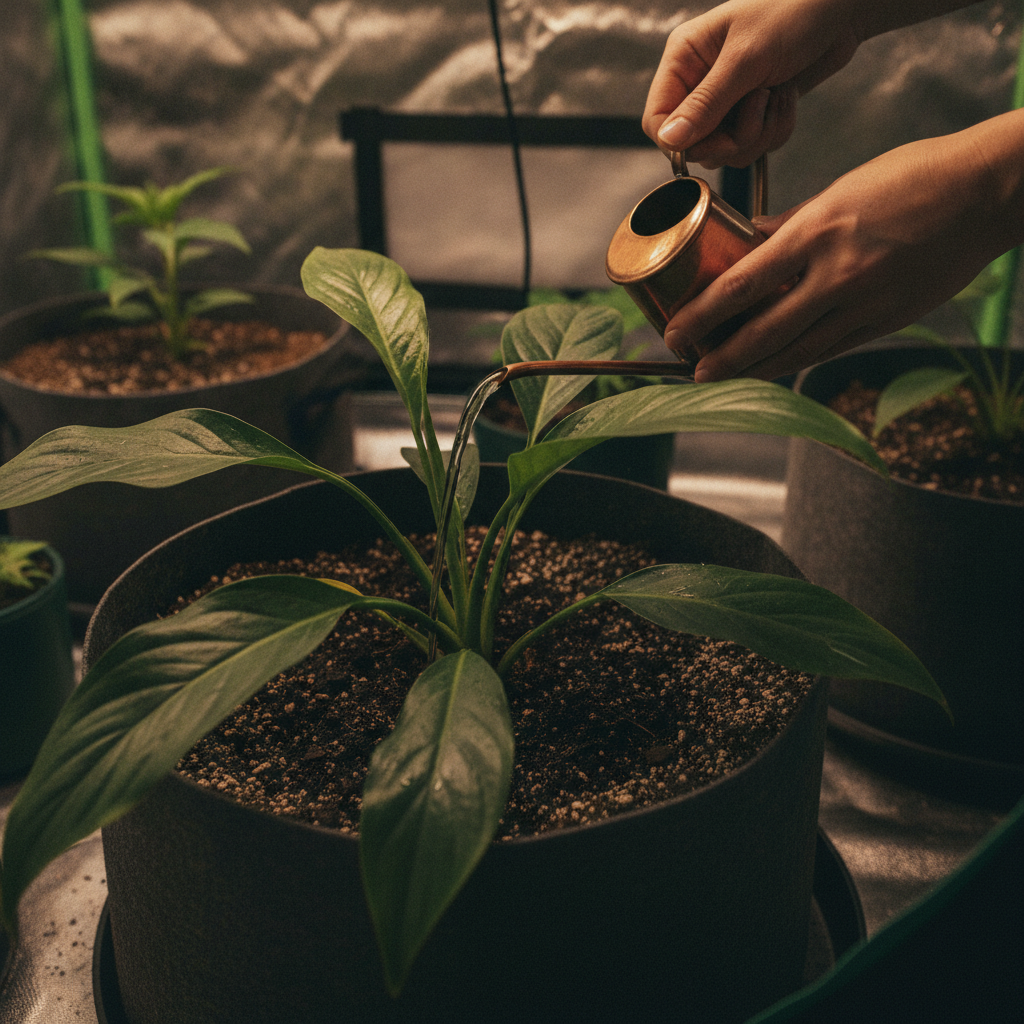
Why Watering Is the Skill That Separates Struggling Grows from Thriving Ones
Ask any experienced grower what kills most beginner plants, and the answer is almost always the same: too much water. Not pests. Not bad genetics. Not cheap lights. Water — or rather, the misguided belief that cannabis needs a drink every day.
At the same time, underwatering causes its own cascade of problems, particularly during August when temperatures climb and plants in active vegetative growth can dry out faster than expected. Getting this balance right is less about following a rigid schedule and more about reading your plant and your growing environment. This guide will give you the tools to do exactly that.
How Cannabis Roots Actually Work (and Why It Matters)
Cannabis roots need two things to thrive: water and oxygen. The problem is that those two things compete for the same space in your growing medium. When soil stays wet for too long, the oxygen gets pushed out, roots suffocate, and a cascade of problems begins — wilting that looks deceptively like drought stress, yellowing leaves, and a welcome mat for root rot pathogens like Pythium.
Healthy roots follow a wet-dry cycle. You water thoroughly, the medium slowly dries out, roots chase the receding moisture deeper into the pot, and the drying medium pulls fresh oxygen in behind it. This cycle is fundamental to strong root development. Interrupt it by watering before the medium has dried adequately, and you're training your roots to stay shallow and lazy — right when they should be expanding.
This is why a rigid "water every X days" schedule rarely works well. The right interval depends on pot size, medium type, ambient temperature, humidity, plant size, and how aggressive the root system is at that particular growth stage.
The Lift Test and Other Ways to Know When to Water
Experienced growers rarely use soil moisture meters. Instead, they use a technique so simple it surprises beginners: they lift the pot.
The Lift Test
Pick up your pot immediately after watering and register how it feels — heavy, obviously. Then lift it every day and notice how the weight changes as the medium dries. When the pot feels noticeably light, almost dramatically lighter than its just-watered weight, it's time to water again. With a bit of practice, this becomes second nature. A 5-gallon fabric pot filled with a well-draining mix might drop from around 8–9 lbs when wet to 3–4 lbs when ready for water again.
Fabric pots actually make this easier than hard plastic containers because they breathe from the sides as well as the bottom, accelerating the drying cycle in a controlled way and making weight differences more pronounced.
The Knuckle Test
For growers using larger containers or heavier mixes, push your finger about an inch (to the second knuckle) into the top of the medium. If it feels dry at that depth, water. If it still feels cool and moist, give it another day. This is a reliable backup to the lift test, though it becomes less accurate in very large containers where the surface can dry while the bottom remains wet.
Watching the Plant
A well-hydrated cannabis plant in its prime holds its fan leaves out horizontally, reaching toward the light. Very early wilt — where leaves look slightly droopy but not yet limp — is a reasonable signal that water is due within the next several hours. Do not wait until the plant is dramatically wilting, as this stresses the plant unnecessarily. But a hint of droop in the evening, when temperatures drop, is usually nothing to worry about.
If leaves are drooping after you've just watered, that's often a sign of overwatering rather than underwatering. Overwatered plants tend to look tired and heavy, with leaves curling slightly downward and a general puffiness to their appearance. See our plant diagnosis tool if you're unsure which problem you're dealing with.
How Much Water to Give Each Time
When it's time to water, water thoroughly. The goal is to wet the entire root zone evenly and flush a small amount of water through the drainage holes at the bottom — typically 10–20% of the container volume. This does two things: it ensures salts and unused nutrients don't accumulate in the lower root zone, and it confirms your drainage is actually working.
For a standard 5-gallon container, this means applying roughly 0.5 to 1 gallon per watering session. For a 3-gallon pot, plan for 0.3 to 0.6 gallons. These are starting points — adjust based on your medium's drainage characteristics.
Never water in small amounts. Giving a half-cup of water to a 5-gallon pot just wets the top inch of soil, encourages shallow roots, and creates uneven drying. Water fully or don't water at all.
Seedlings Are a Special Case
In the first 1–2 weeks after germination, seedlings have tiny root systems that don't yet extend to the edges of the pot. Watering the full container at this stage will leave most of the medium wet for too long, inviting damping off. Instead, water in a small circle around the base of the seedling — just a few inches in diameter — and gradually expand that circle as the plant and its roots grow. Many growers use a spray bottle or a small watering can with a gentle rose head for this stage.
Water Quality: Temperature, pH, and Chlorine
The water itself matters as much as the timing. Three factors to manage: temperature, pH, and chlorine content.
Water Temperature
Use water at or near room temperature — ideally between 65°F and 72°F (18–22°C). Cold water from the tap shocks roots and temporarily slows nutrient uptake. In August, if your water sits in a warm hose or outdoor container, it can get too hot. Aim for that middle range and you won't have problems.
pH
This is non-negotiable. Cannabis grown in soil takes up nutrients most efficiently when the root zone pH stays between 6.0 and 7.0, with 6.2–6.8 being the sweet spot. In soilless or hydroponic systems, that range narrows to 5.5–6.5.
Water that's too alkaline (high pH) or too acidic (low pH) locks out specific nutrients even when they're present in adequate amounts — this is called nutrient lockout, and it's responsible for a huge percentage of the "nutrient deficiency" problems growers diagnose incorrectly. Always check and adjust your water's pH before you add it to the pot.
You'll need a reliable pH meter for this. A decent meter will last years and pay for itself in plants saved. Check out our equipment guide for current recommendations, or see our dedicated pH and EC meter article for a full breakdown.
Chlorine and Chloramine
Standard municipal tap water contains chlorine, which dissipates within 24 hours if you leave water in an open container. However, many US water systems now use chloramine instead of chlorine, and chloramine does not off-gas with sitting. Chloramine can disrupt the beneficial microbial life in organic soil mixes like FoxFarm Ocean Forest, which relies on living biology to make nutrients available to your plants. If you're growing organically and your municipality uses chloramine (check your water report online or call your utility), consider using a simple carbon filter or a small amount of sodium thiosulfate to neutralize it.
Watering Frequency by Growth Stage
As a rough starting framework — before you dial in your specific environment — here's how watering needs typically shift across growth stages:
Seedling Stage (Weeks 1–2)
Water every 2–3 days in a small zone around the base. The goal is keeping the immediate root area moist but not saturated. If using a humidity dome, you may need to water even less frequently.
Early Vegetative (Weeks 3–5)
Every 2–3 days as a starting point, but begin doing the lift test. Root mass is expanding and the plant's water demand is increasing. This is when the wet-dry cycle starts to become really important for driving root development.
Late Vegetative / Pre-Flower (Weeks 6–8)
In August, outdoor plants in peak veg can move a tremendous amount of water — especially on hot days above 85°F. Some large outdoor plants may need water every day or every other day in genuine summer heat. Indoor plants under controlled conditions typically settle into a rhythm of every 2–3 days. Watch the plant and the pot weight; don't assume.
Flowering
Water demand typically remains high through early and mid-flower, then tapers off in the final 1–2 weeks as the plant approaches harvest and you begin flushing (if you choose to flush). Overwatering during late flower is a common cause of bud rot, particularly in dense indoor environments with limited airflow. This is where good ventilation — like the AC Infinity CLOUDLINE T4 — becomes critical not just for temperature but for humidity management at the canopy level.
Watering Technique: How to Actually Do It
The mechanics of watering are straightforward but worth covering explicitly.
- Water slowly and evenly. Pour in circles around the base of the plant, moving outward toward the container edges. This ensures even saturation across the whole root zone rather than creating a wet channel down the center.
- Confirm drainage. Water until you see runoff from the drainage holes. If no water emerges after applying what should be a sufficient volume, your drainage may be blocked — check the holes aren't clogged and that your pot isn't sitting in pooled water.
- Don't let pots sit in standing runoff. Empty saucers promptly. Cannabis does not like wet feet.
- Water at the start of the light period (or at dawn for outdoor grows). This gives the medium the full active period to begin drying and ensures roots have access to oxygen during the plant's peak activity hours.
- Avoid watering at lights-off (or at dusk outdoors) when temperatures drop. Cool, wet soil at night is a recipe for root problems and fungal issues.
Watering and Nutrients: How They Interact
Most growers don't feed nutrients at every single watering. A common approach — particularly with liquid nutrient lines — is to alternate: water with nutrients, then plain pH-adjusted water, then nutrients again. This prevents salt buildup in the medium and gives you a chance to flush any accumulation.
If you're using a pre-amended living soil like Ocean Forest, you may not need to add nutrients for the first 4–6 weeks at all. The soil contains enough to sustain early growth. Once plants show signs of slowing down — lighter green new growth, slower internode development — that's typically the signal to start feeding.
For growers who want a straightforward feeding program designed specifically for cannabis, ILGM's Bergman's Plant Food takes the guesswork out of NPK ratios across growth stages, which pairs well with a dialed-in watering schedule.
Common Watering Mistakes and How to Avoid Them
Watering on a Fixed Daily Schedule
The calendar doesn't know what your plant needs. A hot, dry August day requires more water than a cool, overcast one. Water based on the plant and pot, not the date.
Using Cold or Unchlorinated Tap Water Without pH Checking
Many tap water sources in US cities come in above pH 7.5 — perfectly fine for drinking, problematic for cannabis. Never skip the pH check.
Watering from the Top When Root Rot Is Suspected
If you suspect root rot (brown, slimy roots visible from drainage holes, foul smell from the medium), reduce watering frequency dramatically and consider a hydrogen peroxide flush at a ratio of 3ml of 3% H2O2 per liter of pH-adjusted water. Do not keep watering normally and hope it resolves.
Ignoring Runoff pH
The pH of your runoff water tells you what the actual root zone pH is, which can differ significantly from what you're putting in — especially if salts have accumulated. Test runoff occasionally and compare it to your input pH. If runoff pH is consistently lower than input by more than 0.5 points, a plain-water flush can help reset the medium.
Outdoor vs. Indoor Watering in August
August creates distinct watering challenges for outdoor grows in states like California, Colorado, Arizona, and the Southeast. Daytime temperatures above 90°F can push large outdoor plants to consume water at a rate that surprises new growers. A 15-gallon container in direct sun on a 95°F day in Sacramento may need water every single day during peak heat.
Outdoor growers should check pots morning and evening during heat waves. Consider moving containers to partial shade during the hottest part of the afternoon (noon–4pm) to reduce evaporation and heat stress simultaneously. In-ground grows have more thermal buffering but also benefit from deep, infrequent watering that encourages roots to go deep rather than shallow surface watering that evaporates quickly.
For indoor growers in August, the challenge is usually the opposite — high ambient temperatures increasing evaporation and straining your cooling systems. If your grow room runs consistently above 82°F, your plants will move water faster than expected and your watering intervals will shorten. See our complete growing guide for managing heat in summer indoor grows.
Choosing the Right Strains If Watering Consistency Is a Challenge
If you travel frequently or find it difficult to water on a consistent schedule, strain selection matters. Autoflowering strains with ruderalis genetics tend to be more forgiving of irregular watering than sensitive photoperiod strains. Fast-finishing varieties that spend fewer weeks in flower also mean less time managing the delicate late-flower watering balance.
Browse our strain finder to filter by difficulty level and growing style. If you're looking to start fresh with proven genetics, ILGM's seed mix packs offer three tested strains per pack at a solid discount — a great way to compare how different cultivars respond to your particular watering approach. For autoflower-specific options, Fast Buds carries a well-curated selection of autos suited to home grows (save 15% with code HGAPP).
Frequently Asked Questions
How often should I water cannabis in a 5-gallon pot?
Every 2–3 days is a reasonable starting point for a mid-sized plant in a 5-gallon container using a well-draining soil mix at indoor temperatures. But use the lift test rather than a fixed schedule — the pot should feel significantly lighter than its just-watered weight before you water again. In hot summer conditions or with a large plant in peak veg, you might water every 1–2 days.
Can I use tap water for cannabis?
Yes, in most cases. The two things to check are pH (adjust to 6.2–6.8 for soil) and whether your municipality uses chloramine. Chlorine off-gasses from sitting water within 24 hours; chloramine requires a carbon filter or neutralizing agent, especially if you're growing in a living organic soil.
My plant is drooping — is it overwatered or underwatered?
Both cause drooping, but the pattern differs. Underwatered plants look light and papery, with leaves that feel dry and curl inward slightly. Overwatered plants look heavy and limp, with leaves that droop like wet tissue and may curl down at the edges. Check the pot weight — a very light pot means underwatering; a heavy pot with drooping leaves almost always points to overwatering. Use our plant diagnosis tool for a more detailed assessment.
Should I water cannabis every day during flowering?
Not necessarily, though large plants under intense lighting in warm environments may need daily water during early and mid-flower. The wet-dry cycle remains important throughout flowering. In the final 1–2 weeks approaching harvest, many growers reduce watering frequency intentionally to slightly stress the plant and may flush with plain water. Daily watering during late flower in humid conditions increases the risk of bud rot.
What's the best time of day to water cannabis?
Water at the beginning of the light period for indoor grows, or at sunrise for outdoor plants. This aligns peak water availability with peak plant activity and gives the growing medium the full day to begin the drying cycle. Avoid watering at lights-off or dusk, when cooler temperatures and reduced transpiration leave roots sitting in wet, oxygen-poor soil for hours.