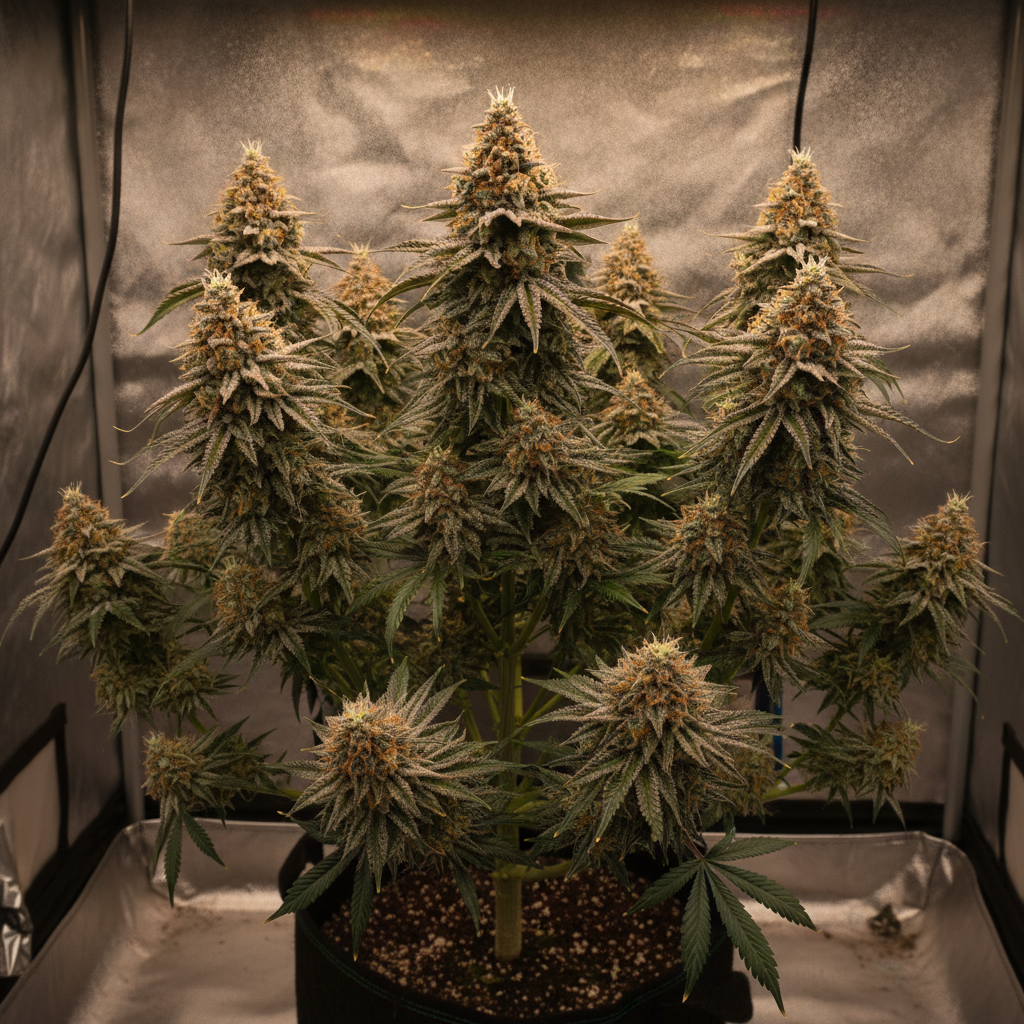
Why OG Kush Belongs in Your Home Grow
Few strains carry the cultural weight and consistent demand of OG Kush. Developed in the early 1990s — likely a cross involving ChemDog, Lemon Thai, and a Pakistani Kush landrace — it became the backbone of the West Coast cannabis scene and remains one of the most cloned and crossed varieties in legal markets today. Dispensaries in California, Colorado, Nevada, and Oregon rarely go a week without OG Kush on the shelf.
For home growers, OG Kush represents a genuine challenge worth accepting. It's not the most forgiving strain, and it has real opinions about its environment. But grow it well and you'll produce dense, heavily resinous buds with a distinctive earthy-pine-fuel aroma that commercial growers struggle to replicate at scale. The home environment — where you control every variable and can respond to problems the same day — is actually ideal for this strain.
If you're still figuring out which strain to try next, the HomeGrow Strain Finder can help you match strains to your setup, climate, and experience level. You can also browse curated genetics at the HomeGrow strain shop.
OG Kush at a Glance
- Genetics: Indica-dominant hybrid (ChemDog × Lemon Thai × Pakistani Kush)
- THC: 19–26% (well-grown home crops frequently hit the upper range)
- CBD: Below 0.5%
- Flowering time: 56–63 days (8–9 weeks) indoors
- Outdoor harvest: Late September to mid-October in most US climates
- Yield (indoor): 1.4–1.8 oz per square foot under optimized conditions
- Yield (outdoor): 2–3 oz per plant is typical for home growers; well-fed plants in warm climates can exceed that
- Plant height: 2–3.5 feet indoors; up to 5 feet outdoors
- Difficulty: Intermediate — manageable with attention to environment
Getting Quality Seeds
OG Kush's popularity means the name gets applied loosely. Buying seeds from a reputable breeder matters more with this strain than with many others, because poor genetics produce plants that look like OG Kush but lack the resin density and terpene profile that make it worth growing.
For feminized photoperiod seeds, ILGM's mix packs include proven OG Kush genetics alongside complementary strains — a cost-effective way to get multiple tested varieties at once, with up to 50% off on bundles. If you prefer autoflowering genetics, Fast Buds carries an OG Kush Auto with a solid track record; use code HGAPP at checkout to save 15%.
With feminized photoperiod seeds, expect germination in 2–5 days using the paper towel method or a seedling tray. Tap roots should be visible at ¼ inch before transplanting into starter medium.
Setting Up Your Grow Environment
Indoor vs. Outdoor in September
If you're reading this in September and planning a new grow, your timing options depend heavily on where you live. In states like California, Arizona, and Florida, outdoor starts are still feasible for autoflowering OG Kush genetics, which can complete a full cycle in 70–80 days regardless of light schedule. Photoperiod OG Kush outdoors in most US states will be entering late flower right now — harvest is typically 2–4 weeks away for plants started in spring.
For indoor growers starting a new cycle in fall, OG Kush is an excellent choice because it doesn't need a long vegetative period and performs reliably under artificial light year-round. Check what your state allows at HomeGrow's state laws page before starting.
Grow Space Requirements
OG Kush stays compact — 2 to 3.5 feet indoors with low-stress training — which makes it well-suited to 4×4 grow tents. You can fit 4 plants in a 4×4 using 3-gallon fabric pots, or 2 plants in 5-gallon containers if you want larger individuals. The HomeGrow equipment guide covers tent sizing and layout in detail.
Fabric pots are worth using with this strain specifically because OG Kush roots are prone to issues in compacted or waterlogged medium. Air-pruning from fabric containers promotes a denser, healthier root structure. VIVOSUN Fabric Grow Pots are an inexpensive and reliable option — a 5-pack of 5-gallon pots runs under $20 and will last multiple grows.
Lighting
OG Kush produces exceptional resin under high-intensity light. During veg, maintain 18 hours on and 6 hours off. Switch to 12/12 to trigger flower. Target a PPFD (photosynthetic photon flux density) of 600–800 µmol/m²/s in veg and 800–1,000 µmol/m²/s in flower for best results.
A 1000W-equivalent LED over a 4×4 space handles this well. The Spider Farmer SF1000 is a solid choice for a 2×2 or single-plant setup; for a full 4×4 with 4 plants, you'll want two of them or a higher-wattage model. Both offer full-spectrum output that supports the terpene development OG Kush is known for.
Temperature and Humidity
OG Kush has a narrow comfort zone compared to hardier strains, and this is where many first-time growers run into trouble. Keep temperatures between 70–80°F (21–27°C) during the light period and no lower than 62°F (17°C) during dark periods. Significant temperature swings — more than 15°F between day and night — stress the plant and can increase susceptibility to pests and mold.
Humidity targets by stage:
- Seedling: 65–70% RH
- Vegetative: 50–65% RH
- Early flower (weeks 1–4): 45–55% RH
- Late flower (weeks 5–8): 40–45% RH
- Final two weeks: Drop to 35–40% RH to encourage resin production
Controlling humidity in late flower is non-negotiable with OG Kush. The strain is notably susceptible to powdery mildew and botrytis (bud rot), particularly in the dense core of its colas. Good airflow — both passive circulation inside the canopy and active exhaust — is essential. The AC Infinity CLOUDLINE T4 is a 4-inch inline fan that handles exhaust for grow spaces up to 4×4 feet quietly and efficiently. Its programmable controller lets you set humidity-based triggers, which is genuinely useful during late flower when conditions can shift quickly.
Soil, Medium, and Nutrients
Choosing Your Medium
OG Kush performs well in quality amended soil and also responds excellently to coco coir grows for growers comfortable with more frequent watering and precise feeding. For beginners and intermediates, a quality organic potting mix with good drainage is the most forgiving starting point.
Start seedlings in a lighter, lower-nutrient mix and transplant into a richer medium once they've established 3–4 nodes. Amending your medium with 20–30% perlite improves drainage significantly — OG Kush roots do not tolerate standing water.
pH Management
Maintain root zone pH between 6.0 and 7.0 in soil, targeting 6.3–6.8 for most of the grow. In coco or hydro, keep pH at 5.8–6.2. OG Kush can show magnesium and calcium deficiencies if pH drifts — a common issue that's easy to misread as a nutrient problem when it's actually a lockout. Check your runoff pH every other watering. If you don't have a reliable meter yet, the HomeGrow Plant Diagnosis tool can help you identify whether a deficiency is pH-related or nutrient-related based on what you're seeing.
Feeding Schedule
OG Kush is a moderate to heavy feeder during flower. It responds well to a balanced approach in veg (higher nitrogen) and a phosphorus- and potassium-forward feed once flower sites develop at week 3–4 of flowering.
A straightforward option is Bergman's Plant Food from ILGM, which is formulated specifically for cannabis and includes stage-appropriate ratios across seedling, growth, and flowering phases. It removes the guesswork from mixing general-purpose nutrients and works well in soil grows.
General feeding targets by EC (electrical conductivity):
- Seedling: 0.4–0.8 EC
- Vegetative: 1.0–1.6 EC
- Early flower: 1.4–1.8 EC
- Peak flower (weeks 4–6): 1.8–2.2 EC
- Flush (final 7–10 days): Plain water at pH 6.3–6.8
Watch for tip burn or clawing — OG Kush will show nitrogen toxicity if you push feeding too hard in early veg. Pull back by 25% at the first sign and reassess before increasing again.
Training OG Kush
OG Kush's natural structure leans toward a central dominant cola with secondary branching that doesn't always catch enough light. Simple low-stress training (LST) — bending the main stem outward and securing it at week 3–4 of veg — opens the canopy and creates multiple flowering sites at an even height. This is one of the highest-return techniques for increasing yield without stress that could trigger hermaphroditism, which OG Kush can be prone to under environmental pressure.
Topping is effective but should be done no later than the 5th or 6th node, and only on healthy, well-fed plants. Give the plant at least 5–7 days to recover before switching to 12/12. If you're growing an autoflowering OG Kush, skip aggressive topping — LST only. See the HomeGrow growing guide for more detail on training techniques by growth stage.
Lollipopping — removing the lower third of foliage and small bud sites — works well with OG Kush 1–2 weeks into flower. It concentrates the plant's energy on upper colas and significantly improves airflow through the lower canopy, which directly reduces mold risk.
Common Problems and How to Handle Them
Powdery Mildew
OG Kush's dense buds and moderately broad fan leaves make it one of the more susceptible popular strains. Prevention is far easier than treatment: maintain humidity below 50% in flower, ensure oscillating airflow hits all parts of the canopy, and avoid foliar sprays during the last 3 weeks of flower. If you catch early signs — white powdery patches on fan leaves — remove affected leaves immediately, increase airflow, and apply a diluted potassium bicarbonate solution (1 tsp per quart of water) to surrounding foliage during lights-on periods.
Spider Mites
Warm, dry indoor conditions attract spider mites, and OG Kush's resinous buds make infested plants harder to treat without affecting quality. At first sign (stippling on upper leaf surfaces, fine webbing underneath), apply neem oil or spinosad-based spray during early veg. In flower, switch to predatory mites (Phytoseiulus persimilis) rather than sprays to avoid residue on developing buds.
Calcium and Magnesium Deficiency
This is among the most common OG Kush issues, showing as brown spots on middle and upper leaves (calcium) or interveinal yellowing (magnesium). Before adding a Cal-Mag supplement, confirm your pH is in range — deficiencies at correct pH warrant supplementation; deficiencies at incorrect pH warrant pH adjustment first.
Harvest Timing for OG Kush
OG Kush finishes at 8–9 weeks of flower indoors. Trichome inspection with a 60–100x jeweler's loupe or digital microscope gives you the clearest indication of readiness:
- All-clear, glassy trichomes: Too early — THC is still developing
- Mostly milky white with a few turning amber: Peak THC, effects will be more cerebral and energetic
- 30–50% amber: THC degrading to CBN, effects become heavier and more sedative — many OG Kush growers prefer this window for the strain's characteristic body effect
For OG Kush specifically, most experienced growers harvest at 20–30% amber trichomes. The strain's earthy-fuel profile comes through most clearly at this stage, and the effect profile — relaxed but mentally present — is what makes it distinctive.
Flush for 7–10 days before harvest in soil grows. Watch for the fan leaves to yellow naturally during flush — this is normal and indicates the plant is pulling stored nutrients, which improves final flavor.
If you're harvesting outdoor plants this September, check morning temperatures. Once overnight lows consistently drop below 50°F (10°C), harvest promptly — cold, wet fall nights accelerate mold development in dense OG Kush colas.
Drying and Curing OG Kush
OG Kush's terpene profile — heavy on myrcene, limonene, and caryophyllene — is volatile. Fast drying at high temperatures destroys these compounds before they're locked in. Take your time.
Hang whole branches in a dark space at 60–65°F (15–18°C) and 55–60% RH. Proper drying takes 10–14 days at these conditions. The buds are ready to jar when small stems snap rather than bend and the outer surface of the buds feels dry to the touch but the interior still feels slightly springy.
Cure in airtight glass jars at 60–65°F and 58–65% RH. Burp jars twice daily for the first two weeks, then once daily through week 4. A 30-day cure is the minimum for OG Kush — 60 days produces noticeably smoother smoke and fuller terpene expression. Boveda 62% humidity packs inside your jars maintain the target RH automatically and eliminate the guesswork from daily monitoring, which is particularly useful if you're curing multiple jars at once.
For a full breakdown of the curing process, see the HomeGrow growing guide — we've covered curing technique in detail there.
Planning Your Next OG Kush Grow
If you're harvesting now and want to run OG Kush again, fall and winter are ideal for indoor grows. With full control over lighting, you can run an 18/6 vegetative period for 4–6 weeks, then switch to 12/12 for flower. A seed-to-harvest timeline of 14–16 weeks is realistic, putting your next harvest in late January or February.
Consider running two plants trained with LST rather than four smaller plants — OG Kush responds well to having room to develop its root zone, and the yield-per-plant difference is significant between crowded and uncrowded setups. The HomeGrow bundles page has equipment starter packages suited to single-tent OG Kush grows if you're building out or upgrading your space.
Frequently Asked Questions
Is OG Kush a good strain for beginner growers?
It's better described as a good challenge for growers who've completed at least one successful grow. OG Kush has specific environmental requirements — particularly around humidity and airflow — that beginners can manage, but will need to stay on top of. If this would be your very first grow, a more forgiving strain like Northern Lights or White Widow will give you a better learning experience. If you've already harvested once and want to step up, OG Kush is a great choice.
Why does my OG Kush smell like pine and diesel? Is that normal?
Yes — that's exactly what well-grown OG Kush should smell like. The combination of myrcene (earthy, musky), limonene (citrus and fuel), and caryophyllene (spicy, woody) creates the signature profile. If your OG Kush smells more like fresh hay or very little at all, it was likely dried too fast or at too high a temperature, which drives off volatile terpenes before the cure can develop them.
How do I prevent bud rot on OG Kush's dense colas?
Keep late-flower humidity at or below 45% RH, ensure oscillating airflow reaches the interior of the plant, and consider defoliating fan leaves around the upper colas at week 4–5 of flower to improve air circulation. In humid climates or outdoor grows, a small fan directly on the plants during damp overnight periods makes a meaningful difference. If you spot any gray-brown discoloration inside a bud, remove the entire affected cola immediately — botrytis spreads rapidly under favorable conditions.
Can I grow OG Kush outdoors on the East Coast?
Yes, with some planning. OG Kush finishes in late September to mid-October, which aligns with harvest windows in most of the mid-Atlantic and Southeast. The concern in the Northeast — New York, Massachusetts, Maine — is that October nights can drop below 50°F and bring heavy rain, both of which accelerate bud rot in OG Kush's dense colas. Starting in early April and selecting a sheltered, south-facing spot with good drainage helps. Some East Coast growers harvest slightly early (25–30 days into ideal trichome window) to beat fall weather rather than risk losing the crop to mold.
What's the difference between OG Kush phenotypes, and does it matter when buying seeds?
OG Kush has several well-known phenotypes — Larry OG, SFV OG, Tahoe OG, and Ghost OG among them — each with slightly different growth habits and terpene emphases. When you buy seeds labeled simply "OG Kush," you may see variation between individual plants from the same pack; this is normal for a strain that has been widely bred and crossed. If phenotype consistency matters to you, buying from a reputable breeder with tested, stable genetics reduces variation. Running multiple seeds from the same pack and selecting the best phenotype for cloning is how many home growers build a consistent OG Kush garden over time.